Belgium’s Complex Taxes: How "Special Tax Status" Works for Foreign Professionals
Why Freelancers Rarely Qualify
If you've been researching a move to Belgium, you've probably stumbled upon the phrase “special tax status” and felt a little spark of hope. It sounds like exactly the kind of loophole nomads love (the Belgian version of Spain's famous Beckham Law), a way to slash your tax bill just for being a foreigner. Maybe someone in a Discord server told you about it. Maybe a forum thread made it sound like a cheat code.
Here's the honest bit: it's real, it's genuinely generous, and it very likely wasn't built for you, though a minority of readers joining a Belgian office of an international group or recruited into a specialist role genuinely do qualify.
Table of Contents
- 1.At a glance
- 2.What the special tax regime actually gives you (and who it's for)
- 3.Who qualifies for Belgium's special tax status? (Spoiler: most freelancers don't)
- 4.If you DO qualify, don't blow the 6-month deadline
- 5.So what actually decides your Belgian tax bill?
- 6.Does working from Belgium make your income automatically tax-free?
- 7.When you leave: the de-registration step nomads forget
- 8.Frequently asked questions
- 9.Bottom line: the regime’s an employee perk. Your real question is residency
- 10.Sources
Moving to Belgium Either Way: Whether or not the special tax status applies to you, your living situation shouldn't be the hard part. Skip the local rental hunt and long lease commitments. Move straight into a premium, fully furnished coliving space in Brussels and plug into an international community from day one!
Belgium's special tax regime applies to foreign executives or employees (and certain researchers) who are either directly recruited from abroad by a Belgian company or temporarily assigned from abroad within a multinational group, subject to a minimum gross annual salary of €75,000. Notice the words “recruited” and “assigned.” This isn't a perk you claim as a solo operator; it needs an underlying employment relationship with a Belgian entity and a minimum salary threshold. If you're a freelancer with a laptop and a handful of international clients, the regime you keep reading about is basically a door that only opens with an employment contract on the other side.
This article walks through what the status actually gives you, runs through a blunt “do you qualify” checklist, and then, because most readers won't qualify, pivots to what genuinely decides a freelancer's Belgian tax bill.
At a glance
- The regime requires an employment relationship. Belgium's special tax status requires an employment relationship with a Belgian entity and a minimum gross salary of € 75,000; no employment, no application.
- It's built for salaried executives and their families, not mobile solo workers. Perks like school fees and cost allowances give that away.
- Residency, not the regime, sets your bill. Whether you're a tax resident or non-resident matters far more to a freelancer than any expat perk.
- “183 days” doesn't decide it here. Belgium looks at your centre of vital interests, though you can prove your main base is abroad under certain conditions.
- De-register when you leave. Skip the town hall step, and Belgium can keep taxing you after you've gone.

What the special tax regime actually gives you (and who it's for)
Let's be fair to the regime; the benefits are legitimate. This isn't a scam or a marketing gimmick. It's a real package designed to make Belgium attractive to high-skilled talent that companies relocate across borders.
The perks, briefly:
A chunk of your compensation can effectively land in your pocket tax-free. Under the 2022 reform, a flat 30% lump-sum of gross remuneration is treated as tax-free, capped at €90,000 per year (Loyens & Loeff, 2022). To show the scale: one illustrative example applies an effective tax rate of 53.5% to an employee earning €100,000 gross under the regime, so the savings are real money, but they're structured around a salary.
Then there's the family side. School fees for children attending primary or secondary full-time tuition at an international school are tax-free and uncapped, provided costs are substantiated with invoices. That's not a benefit aimed at a 27-year-old designer hopping between co-working spaces; it's built for an executive relocating a whole household.
One historical note nomads should ignore: older guides talk up a “foreign travel exclusion,” the portion of an expatriate's salary corresponding to business days worked abroad being exempt from Belgian tax. That mechanism belonged to the old, pre-2022 regime and was abolished by the 2022 reform, which replaced it with the flat 30% lump-sum allowance. Even when it existed, it applied to salary, calculated on business days, from an employment contract. Freelance invoices to your own clients never slotted into that mechanism at all.
So the shape of the whole thing becomes clear: every generous feature, including the lump-sum allowance and the school fees, assumes there's a payroll and an employer underneath it. Which brings us to the part where you find out if that's you.
Who qualifies for Belgium's special tax status? (Spoiler: most freelancers don't)
Below are the four gates you have to walk through. If you hit a single “no,” you’re out with no partial credit.
-
Gate 1: Are you new to Belgium?
Under the 2022 regime, both non-Belgian and Belgian nationals can qualify, provided they have not been tax-resident in Belgium, have not lived within 150 km of the Belgian border, and have not been subject to Belgian non-resident professional income tax during the 60 months preceding their start of employment in Belgium. Been here recently as a resident? That’s likely a no.
-
Gate 2: Were you recruited or assigned by a company?
This is the big one. The expatriate must have been either directly recruited abroad by a Belgian company, or temporarily assigned from abroad to a Belgian entity that is part of an international group present in at least one other country. Read that as a freelancer, and the problem is obvious: you weren’t “recruited abroad by a Belgian company,” and you weren’t “assigned” from a foreign entity. You have clients, not an employer. This is where the vast majority of nomads fall out.
-
Gate 3: Is this salaried employment, not freelance income?
Everything about the regime, from allowances to the lump-sum exemption, runs on salary. Self-employed invoicing doesn’t map onto it.
-
Gate 4: Can you file jointly with an employer?
The application must be filed jointly by the expatriate and their Belgian employer with the Director of Foreign Taxes within six months of the month in which the assignment in Belgium started.
The blunt summary: no employer relationship means no co-filing, which means no regime. It's not that freelancers are unwelcome in Belgium, but this specific status simply was never designed to include them. If you're self-employed, you can stop chasing this particular dream and start focusing on what actually governs your tax bill.
If you DO qualify, don't blow the 6-month deadline
A minority of readers will clear all four gates, where maybe they're joining a Belgian office of an international group or getting recruited into a specialist role. If that's you, one number matters more than any other: six months.
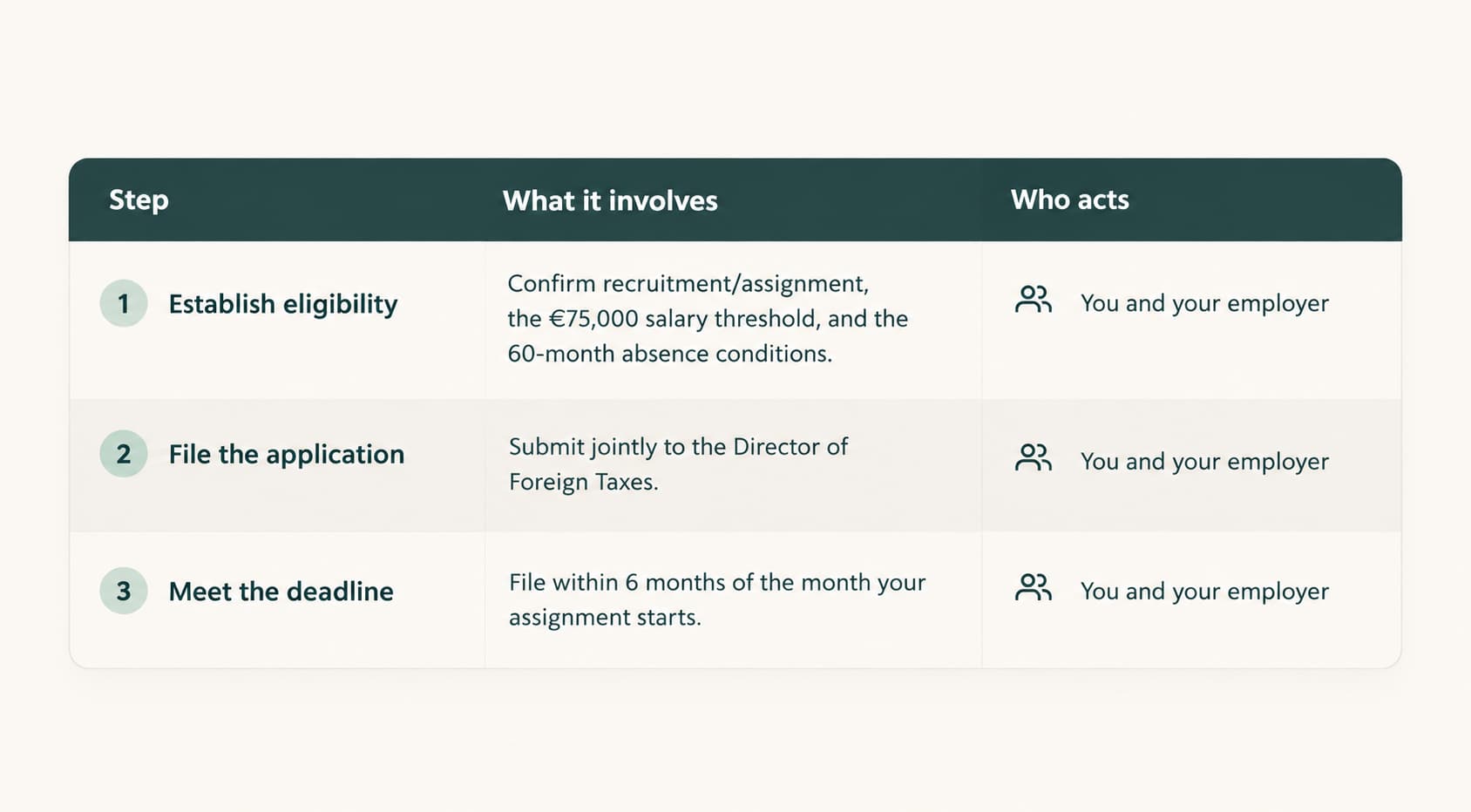 That window is tight. If you qualify, get your employer moving on the paperwork early.
 So what actually decides your Belgian tax bill?
Regime aside, here's the question that actually matters for a freelancer or remote worker: are you a Belgian tax resident or not?
This single line determines almost everything. Belgium taxes residents on their worldwide income, while non-residents are taxed only on Belgian-source earnings (PwC Tax Summaries). Worldwide versus Belgian-only is a massive difference when your income comes from clients scattered across the globe.
Does the “183 days” rule apply in Belgium?
Many nomads assume tax residency is a simple day-count: stay under 183 days, and you're safe. Belgium doesn't play that way. Residence is determined by your “centre of vital interests” or habitual abode, not merely by the number of physical presence days.
In practice, that means it's about where your life actually is, be it your home, your relationships, or your economic base. Under certain conditions, a person residing in Belgium who can prove their main centre of interest remains abroad can be considered a non-resident for tax purposes. But you have to prove it, not just assume it.
A worked example
Maya, a freelance developer, moves to Brussels for a year. She's heard about “special tax status” and assumes she'll grab it.
First reality check: there's no employer to co-file with, so the regime is off the table immediately.
So now it's the residency question. If Maya rents a flat, settles into Brussels life, and her centre of vital interests shifts to Belgium, she risks being treated as a resident, meaning Belgium could tax her worldwide freelance income. If her genuine base stays abroad (family, main home, economic ties), she may be classed as a non-resident, taxed only on Belgian-source income.
Either way, the rates bite. Belgium applies progressive personal income tax rates ranging from 25% to 50% for non-resident individuals, with 25% applying to the first €16,320 of taxable income and 50% applying to income exceeding €49,840 (FPS Finance, income year 2025). That top band arrives fast.
Bottom line for Maya: the special regime is irrelevant to her. Her tax bill is decided entirely by whether her centre of vital interests sits in Belgium or abroad.
This is general information, not tax advice. Rules and figures change, and everyone's situation is different, so confirm your position with a Belgian tax advisor before making any moves.
Does working from Belgium make your income automatically tax-free?
There's a comforting story nomads tell themselves: “I'll just work remotely from a café in Ghent; my income is foreign, none of it touches Belgium.” It's tidy. It's also risky.
Belgium's tax authorities look at economic activities and beneficial ownership structures beyond physical presence to determine taxable presence, meaning even temporary business activities can trigger tax obligations (Baker McKenzie InsightPlus). In plain terms: they care about what you're actually doing on Belgian soil, not just how many nights you slept there. Running your business from Belgium, even briefly, can be enough to create a taxable footprint. “But my clients are abroad” isn't the automatic shield people think it is.
This is exactly why the residency question isn't academic. Before you assume your remote setup is invisible to the Belgian tax office, get clarity on where your activity legally lands.
When you leave: the de-registration step nomads forget
Here's a trap tailor-made for mobile people: you assume leaving Belgium means Belgium leaves you alone. Not quite.
When leaving Belgium, you should formally de-register from your commune (town hall) to end your Belgian tax residency status, and a final Belgian tax return covering the year of departure is generally required (Taxpatria). Skip that town hall step, and on paper you might still “live” in Belgium, which means you can keep getting taxed like you never left.
Settled expats tend to leave once, deliberately, with a lawyer. Nomads bounce. You might treat your Belgian chapter as casually closed and flat-handed with bags packed while the administrative record still shows you registered at your old commune. The fix is boring but essential: when you go, formally de-register at the town hall and file your exit return. It's the mirror image of registering when you arrived, and forgetting it is one of the more expensive ways to say goodbye to a country.
Frequently asked questions
Can a freelancer or self-employed person get the special tax status?
Realistically, no. The regime is filed jointly with a Belgian employer and runs on salaried compensation above a €75,000 gross threshold. A self-employed person invoicing their own clients has no employment relationship to build the application on and no salary structure for the allowances to attach to because the core mechanics simply don’t fit.
Am I a Belgian tax resident if I live there as a nomad?
It depends on your centre of vital interests, not a day count. If your genuine life base, like your home, family, and economic ties, are in Belgium, you’re likely a resident. If your main centre of interest stays abroad and you can demonstrate it with evidence like a foreign home, family location, and economic ties, you may be treated as a non-resident even while physically living in Belgium.
As a non-resident, is my foreign client income taxed in Belgium?
Non-residents are taxed only on Belgian-source income, not worldwide earnings. So income from foreign clients generally isn’t taxed, provided you’re genuinely a non-resident, and your activity in Belgium doesn’t create a taxable presence of its own. Watch that second condition: Belgian authorities weigh what you actually do on Belgian soil, so even temporary business activity here can create a footprint.
Is the special tax status the same as Spain’s Beckham Law?
People compare them because both are “expat tax perks,” but they’re not interchangeable. One concrete contrast: Belgium’s regime is heavily employer-tied — it needs an employment relationship with a Belgian entity and a €75,000 minimum salary, so a self-employed person can’t use it. Don’t assume a hack that works in one country maps onto another.

Bottom line: the regime’s an employee perk. Your real question is residency
Belgium’s special tax status is a genuinely good deal for salaried executives and specialists who get relocated by a company that co-files the paperwork. If that’s not you, it’s not a loophole you’re missing out on; it’s simply a different lane.
For a freelancer or digital nomad, the number that actually shapes your Belgian tax bill isn’t hidden in some expat regime: it’s your residency status. Resident means worldwide income; non-resident means Belgian-source only, judged by your centre of vital interests, not a calendar.
Nail that question down first. Figure out whether your real base is in Belgium or abroad, understand what “working from here” can trigger, and remember to de-register cleanly when you go. And before you commit to anything based on a forum post or this article, sit down with a Belgian tax advisor because getting residency wrong is far more expensive than a consultation.
Sources
- Loyens & Loeff — New tax regime for impatriates and impatriate researchers (2022)
- PwC Worldwide Tax Summaries — Belgium, Individual, Taxes on personal income
- FPS Finance (Belgian tax authority) — Tax rates
- Baker McKenzie InsightPlus — Permanent establishment risk from cross-border telework
- Taxpatria — Formalities when leaving Belgium
This article is for informational purposes only and does not constitute tax or financial advice. Consult a qualified Belgian tax advisor or licensed financial advisor before making any decisions about your residency, tax position, or investments.