The Real Cost of Moving to Paris: The €4,000–€6,000 Wall Nobody Warns You About
Paris rent isn't the real problem — it's the €4,000–€6,000 in upfront costs before month one. Here's the honest landing-fund math for nomads, plus the free Visale guarantor.
Table of Contents
- 1.Key takeaways
- 2.Where does €4,000–€6,000 actually go before you unpack?
- 3.What are the upfront costs of renting a flat in Paris?
- 4.How much cash do you actually need before you fly?
- 5.What are the three layers of a landing fund?
- 6.How do you size the living runway?
- 7.Why is the '€400 a month' number a trap for nomads?
- 8.How does the French guarantor system work for foreigners?
- 9.Frequently asked questions
- 10.Bottom line: budget the wall, not the rent
Skip the €4,000–€6,000 Wall: While you're budgeting for deposits, agency fees, and guarantor paperwork, Cohabs cuts that landing cost out entirely. Move straight into a premium, fully furnished coliving space in Paris — no deposit scramble, no agency fees, and an international community from day one!
Key takeaways
- Budget €4,000–€6,000 in upfront costs — deposits, agency fees, and move-in admin — before your monthly life in Paris even begins (as reported by the Biennote Substack account, unverified against wider market data).
- Under French law (Loi ALUR, 2014), the security deposit for an unfurnished flat is capped at one month's rent, and agency fees are capped at one month's rent excluding VAT — so several of these line items have legal ceilings.
- Build a "landing fund" before you fly: upfront costs + two months of living runway + an emergency buffer.
- The famous €400/month figure is the floor of the spectrum (Au Pair arrangements with lodging included) — it does not apply to a nomad paying market rent.
- If you don't have a French guarantor, Visale (run by Action Logement) is a free government guarantor service; commercial alternatives like GarantMe or Cautioneo charge a percentage of annual rent.
Everyone tells you Paris is expensive. Almost nobody tells you where it's expensive. The mental image you've built from scrolling — an Au Pair somehow surviving on €400 a month on one end, a nepo baby posting from the Ritz on the other — is exactly the problem. Those two extremes don't overlap with your reality, and they definitely won't give you the clear picture you need to actually budget for a move.
Here's the part that catches most people off guard: it's not usually the rent that breaks you. For many renters it's everything you have to pay before the rent even starts. Before you unpack a single box, before your first Parisian coffee, before your salary lands — you can already be several thousand euros deep.
Much of what follows draws on a first-person account from a young professional who moved to Paris and was living there by 25, originally from Ukraine, writing on the Biennote Substack. Not a tourism brochure. Not a brand pitch. Just someone who did the thing and kept the receipts. That's the lens we're using — honest numbers and the one figure that should shape your entire plan: the €4,000–€6,000 wall you can hit on day one.
Where does €4,000–€6,000 actually go before you unpack?
As the Biennote account describes it, before you even start living in Paris, you'll likely pay €4,000–€6,000 in upfront costs. That's a lump sum big enough to ruin your first month if it surprises you, but it stops being scary the moment you break it into named line items.
Here's roughly where that money physically goes when you rent a flat in Paris. The exact split depends heavily on your apartment, your landlord, and whether you go through an agency, but the total tends to land inside that band. (Note: this range comes from a single first-hand account, not verified market data.)
What are the upfront costs of renting a flat in Paris?
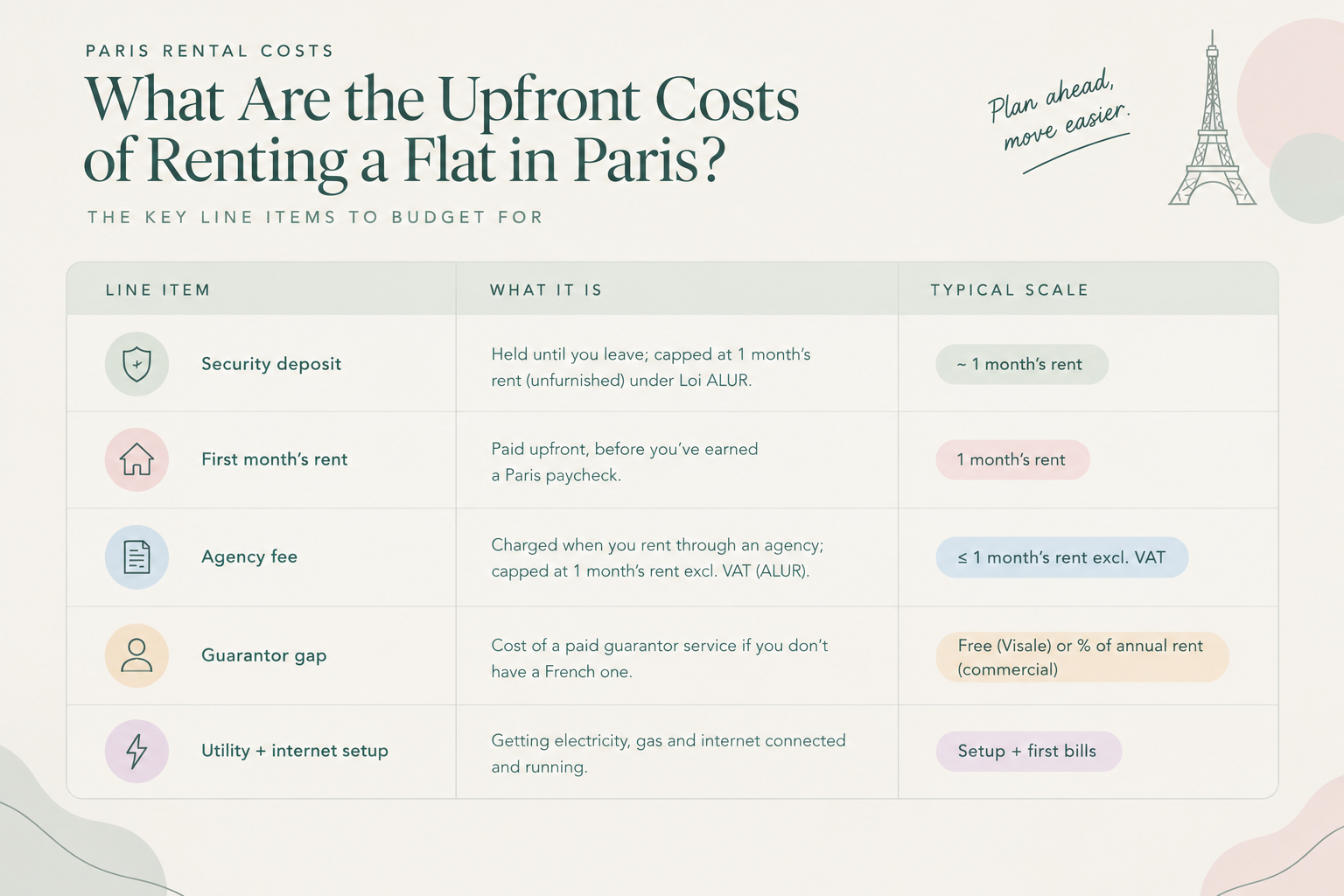
Why does each one hit?
- The deposit isn't gone forever, but it's gone now. Under French law it's returned only when you move out, so it can't be part of your living budget.
- First month's rent stacks directly on top of the deposit. Two months of rent, effectively, on day one.
- The agency fee is the one people forget. If your flat comes through an agency, expect a separate charge — legally capped at one month's rent excluding VAT. Rent directly from a landlord and this line disappears entirely.
- The guarantor gap trips up nearly every foreigner. French landlords often want a French-based guarantor. No guarantor? Visale (Action Logement) is a free government service for eligible renters; commercial services like GarantMe or Cautioneo charge a percentage of your annual rent instead.
- Setup costs for electricity and internet feel small individually and add up fast, especially if your place isn't move-in ready. A furnished short-stay rental that bundles utilities can cut this line down.
The point isn't the precise euro figure for each row — it's that the €4,000–€6,000 stops being one terrifying wall and becomes a checklist you can save toward, one line at a time.
How much cash do you actually need before you fly?
Upfront costs are only the first hit. The mistake is treating that €4,000–€6,000 as your whole budget, landing broke, and then discovering that Paris has more surprises waiting. The Biennote author's philosophy is blunt: plan for the worst and hope for the best, because not all of these costs may apply to you, but some quietly will.
So let's turn that into an actual number to save toward. Call it your landing fund — the liquid cash you want sitting in your account before you book the flight.
What are the three layers of a landing fund?
- Upfront costs (€4,000–€6,000). The deposit, first rent, agency fee, guarantor gap, and setup costs from the previous section. This layer is the wall.
- Two months of living runway. Rent, groceries, transport, phone, and daily life for eight weeks. This buys you breathing room while your income stabilises, your bank account opens, or your first invoice clears.
- An emergency buffer. The layer for the thing you didn't plan for — because in Paris, there's usually a thing you didn't plan for.
How do you size the living runway?
How much two months of runway costs depends entirely on how you live. The spectrum is enormous. At the very lowest end, an Au Pair in Paris can survive on as little as €400/month — but that figure comes with a huge asterisk we'll get to shortly. A nomad renting a studio at market rate pays far, far more than that. Do not size your runway off the €400 floor.
The honest move is to estimate your realistic monthly spend, double it for the two-month layer, stack it on top of your upfront costs, and add your emergency buffer on top of that. That sum is your landing fund. Save it before you fly, and the €4,000–€6,000 wall becomes a speed bump instead of a cliff.
Why is the '€400 a month' number a trap for nomads?
That €400 figure is real — but it's real for a very specific person, and that person is almost certainly not you.
The Biennote author uses it deliberately as the bottom of the range, alongside the image of a nepo baby at the Ritz at the top, to make a single point: scrolling TikTok — from an Au Pair surviving on €400 a month to a nepo baby living at the Ritz — will not paint you the clear picture you need.
Who is the €400 actually for?
An Au Pair arrangement typically bundles in the two most expensive things in Paris: lodging and often food. When your accommodation is provided and some meals are covered, €400 for everything else becomes plausible. That's not a Paris hack. That's a completely different living arrangement with a completely different cost structure.
A digital nomad paying market rent on a studio has none of those shortcuts. No provided room. No family kitchen. You're absorbing the full weight of rent, utilities, groceries, and transport yourself. Anchoring your budget to €400 because you saw it online is how people end up blindsided in week three.
The takeaway: treat €400 as the theoretical floor of a very wide spectrum, understand it assumes lodging and food are handled for you, and build your own runway from your own realistic rent — not from someone else's arrangement.

How does the French guarantor system work for foreigners?
For most foreign renters, the guarantor requirement is the single most confusing part of getting a Paris flat — and it's a real upfront cost line.
French landlords commonly ask for a caution solidaire: a guarantor, usually based in France, who agrees to cover your rent if you can't. If you've just arrived, you almost certainly don't have one.
Your options:
- Visale — a free guarantor service run by Action Logement, a French public body. If you're eligible (it targets people under 30 and certain other tenants), it acts as your guarantor at no cost.
- Commercial guarantor services — companies like GarantMe or Cautioneo stand in as your guarantor for a fee, typically charged as a percentage of your annual rent. This is the paid version of the same fix, and it's another upfront line to plan for.
Sort this out before you start viewing flats. A guarantor solution in hand makes you a far stronger applicant in a competitive rental market.

Frequently asked questions
-
How much money do you need upfront to move to Paris?
Budget €4,000–€6,000 before your regular monthly expenses even begin (as reported in a first-hand Biennote account, not verified against market data). That covers the deposit, first month's rent, agency fees, a paid guarantor service if you don't have a French guarantor, and utility and internet setup. This is separate from — and on top of — your ongoing cost of living.
-
What's the single biggest hidden cost of moving to Paris?
The upfront wall itself. It's not one line item, it's the stacking of several: deposit plus first rent plus agency fee plus guarantor gap plus setup costs, all due before you've earned a euro locally. Individually each feels manageable. Together they can total €4,000–€6,000, and they arrive all at once.
-
Can you trust TikTok for realistic Paris cost advice?
No. TikTok shows the extremes — an Au Pair on €400 a month at one end, luxury lifestyles at the other — and neither reflects a working nomad paying market rent. Those clips are entertainment, not a budget. Build your numbers from your own realistic rent and living costs instead.
-
What is a Visale guarantor and how does it work?
Visale is a free guarantor service run by Action Logement, a French public body. If you don't have a French-based guarantor, Visale can act as one for eligible renters (it targets people under 30 and certain other tenants), which removes the cost of a paid commercial guarantor. Commercial alternatives like GarantMe or Cautioneo do the same job for a fee based on a percentage of your annual rent.
-
Is €400 a month a realistic Paris budget?
Only if your lodging and food are provided, as in an Au Pair arrangement. It's the theoretical floor of a very wide spectrum. A nomad renting a studio at market rate pays significantly more, because none of the big-ticket items are covered for them.
Bottom line: budget the wall, not the rent
Paris rent is usually the cost you can see coming. It's the €4,000–€6,000 you have to hand over before month one that catches people out. Save your landing fund first: upfront costs, two months of runway, and a buffer. Sort your guarantor (Visale if you're eligible) before you view flats. Clear that wall, and the monthly side becomes far more manageable. Plan for the worst, and the city is much less likely to humble you.