US Health Insurance Explained: Navigating Deductibles, HMOs, and PPOs
If you've ever stared at a US health insurance page and felt your brain quietly shut down, you're not imagining it. The system is a wall of acronyms —HMO, PPO, EPO, POS, HDHP — stacked on top of words nobody ever bothered to define for you, like deductible and coinsurance. It's confusing, and not entirely by accident.
Table of Contents
- 1.Key Takeaways
- 2.What Do Premium, Deductible, Copay, Coinsurance, and Out-of-Pocket Max Actually Mean?
- 3.How These Connect in Real Life
- 4.What Do the Five Plan Types (HMO, PPO, EPO, POS, HDHP) Actually Mean?
- 5.Why Is an HMO the Plan Most Likely to Burn a Nomad?
- 6.Which Plan Actually Moves With You? (The Nomad Decision Matrix)
- 7.How Does the HDHP + HSA Combo Reward a Healthy, Mobile Person?
- 8.Frequently Asked Questions
- 9.Bottom Line: Pick for How Often You Move, Not Just the Monthly Price
But here's the thing most guides skip, and it's the one thing that actually matters if you don't stay put: the letters on your plan often matter less than whether the coverage follows you when you move.
Because you're not the person these plans were designed for. They were built for someone who lives in one zip code, sees the same doctor for a decade, and never has to ask “wait, am I still covered here?” You're going to ask that question constantly. So every plan type below gets run through a single test: will this thing still cover me when I'm not where I signed up?
One Less Thing to Sort: While you're untangling HMOs and PPOs, let Cohabs handle your living logistics. Skip the stressful local rental loops, utility installations, and long contracts. Move straight into a premium, fully furnished coliving space in NY or Washington DC and connect with an international community from day one!
Key Takeaways
- An HMO ties your eligibility to where you live or work — move away and your network can vanish, leaving non-emergency care uncovered.
- A PPO is the more move-friendly setup: out-of-network care is still covered at a reduced level, and you usually don't need a Primary Care Physician or referrals. The trade-off is materially higher premiums, which matters on variable nomad income.
- Emergencies are generally covered no matter your plan or location. It's the non-emergency stuff that trips up movers.
- Some HMOs have reciprocity arrangements for care in other areas — but you have to read your specific plan brochure to confirm it, because it's never guaranteed.
- Pick based on your movement pattern, not just the monthly premium. A cheap plan that only works in one city isn't cheap if you leave that city. But if you actually stay in one metro most of the year, a lower-cost HMO may beat paying for PPO flexibility you rarely use.
What Do Premium, Deductible, Copay, Coinsurance, and Out-of-Pocket Max Actually Mean?
Before any plan comparison makes sense, you need the vocabulary. On variable freelance income, these terms hit your budget differently than they would a salaried employee with predictable pay, so here they are in plain terms.
- Premium — the fixed amount you pay every month to have insurance at all, whether or not you ever see a doctor.
- Deductible — what you pay out-of-pocket for covered services before your insurance starts paying anything.
- Copay — a fixed fee you pay for a specific service, like a set amount for a doctor visit.
- Coinsurance — the percentage of the cost you share with your insurer after you've met your deductible.
- Out-of-pocket maximum — the annual cap on what you pay for covered services (it does not include your premiums). Once you hit it, your insurer pays 100% of covered costs for the rest of the plan year.
How These Connect in Real Life
Say you go to a doctor and haven't spent anything yet this year. If you still have a deductible to meet, you might pay the full negotiated cost of that visit yourself — that's the deductible doing its thing.
Once you've paid enough over the year to clear your deductible, the split changes. Now you might just owe a copay at each visit, or a coinsurance percentage while the insurer covers the rest. Keep spending and eventually you hit your out-of-pocket maximum — after that, the insurer picks up everything for the rest of the year.
So the monthly premium is the price of having insurance. The deductible, copay, and coinsurance are the price of using it. Two different buckets of money, and both matter when you're budgeting on freelance income.
What Do the Five Plan Types (HMO, PPO, EPO, POS, HDHP) Actually Mean?
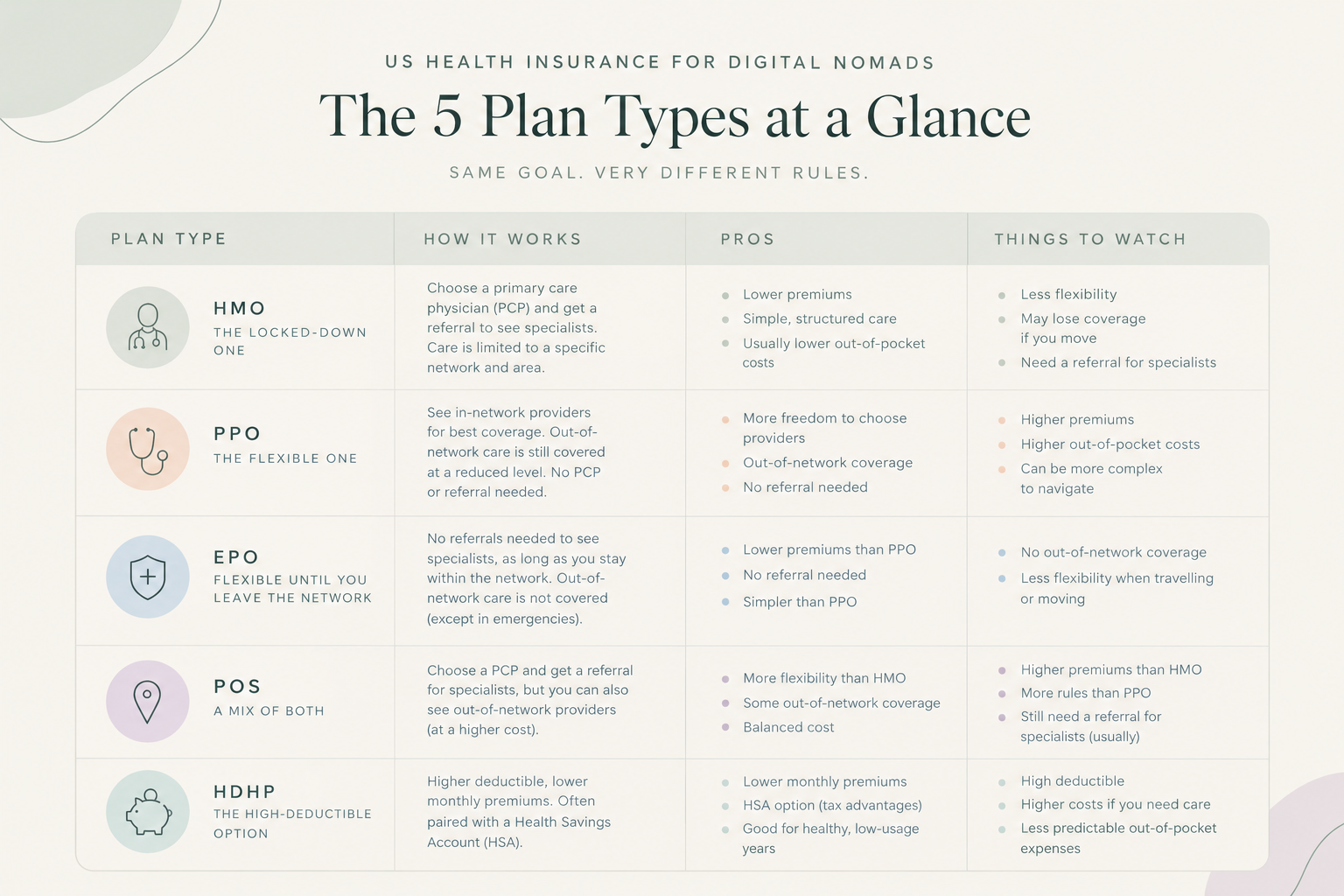
Every US plan is basically a set of rules about which doctors you can see and how much freedom you get. Here’s each type without the jargon.
- HMO — The Locked-Down One
Most HMOs ask you to choose a Primary Care Physician (PCP) who handles your general care, and you need a referral from that PCP before you can see a specialist. Care runs through a network in a specific area. It’s structured and usually cheaper, but it keeps you on a short leash. - PPO — The Flexible One
A PPO gives you the highest level of coverage when you use providers in its network, but out-of-network care is still usually covered at a reduced level. You typically don’t need a PCP or a referral to see a specialist. More freedom, generally higher premiums. - EPO — Flexible Until You Leave the Network
An EPO looks relaxed at first: you usually don’t need referrals to see specialists as long as you stay inside the network. EPO plans often feature lower premiums offset by higher deductibles. The catch — go out-of-network for non-emergency care and you’ll likely pay the full cost yourself. - POS — The Hybrid
A POS plan mixes the two. Like an HMO, it usually requires a PCP and referrals. But like a PPO, it offers some out-of-network coverage, typically with a higher copay. - HDHP — The Low-Premium Bet
A High Deductible Health Plan flips the cost structure: you pay lower premiums each month but higher out-of-pocket costs when you actually get care. Preventive care is generally covered for free. It’s a bet that you’ll stay healthy — and it pairs with a savings account that’s worth understanding, covered later.

Why Is an HMO the Plan Most Likely to Burn a Nomad?
An HMO restricts coverage to a defined geographic service area, which makes it the plan most likely to leave you stranded when you relocate. Most guides compare HMOs and PPOs on a “cost versus choice” axis. That's fine if you live in one place. For you, geographic lock-in matters more.
Your Eligibility Is Tied to a Place
Here's the part that catches people off guard. According to the U.S. Office of Personnel Management's Federal Employees Health Benefits plan types guidance, an HMO's eligibility to enroll is determined by where you live or, for some plans, where you work. It provides care through a network in a particular geographic or service area. So the plan isn't just inconvenient when you move — your very ability to be on it can be tied to an address you no longer keep.
The Out-of-Network Cliff
Now layer on how HMOs treat outside providers. The OPM notes that with an HMO, care from a provider not in the plan's network is not covered unless it's emergency care or the plan has a reciprocity arrangement.
Read that again with your lifestyle in mind. You move to a new state or spend a few months somewhere else. Your HMO network doesn't exist there. You get sick — not ER-level sick, just regular-doctor sick. That visit is now out-of-network and non-emergency, which means you're paying the whole bill. Your “cheap” plan just became a piece of paper.
The One Escape Hatch
There is a workaround, but it's not automatic. Some HMOs have reciprocity arrangements with HMOs in other service areas for non-emergency care when you travel or are away for extended periods, per the OPM. The key detail: plans that offer this discuss it in their brochure. So if you're eyeing an HMO anyway, open the plan brochure and search for “reciprocity.” If it's not spelled out there, assume it doesn't exist.
Which Plan Actually Moves With You? (The Nomad Decision Matrix)
Forget “best plan” — there isn't one. There's only the plan that matches how much you move. So here's every type scored against the questions you actually care about: does it lock you to a place, does out-of-network care get covered, and how much PCP/referral friction stands between you and a doctor?
The Short Version
If you move a lot, the PPO is the one that most reliably travels with you, because out-of-network care doesn't drop to zero — it just costs more. That flexibility comes at a higher monthly premium, so if you actually park in one metro for most of the year, the PPO premium gap may not be worth it. The EPO looks appealing because you skip referrals, but out-of-network non-emergency care leaves you paying full cost. The POS sits in between: some out-of-network coverage, but you're still tethered to a PCP and referral chain. And the HDHP isn't really a network type at all — it's a cost structure that can sit on top of different networks, so judge it on premiums versus out-of-pocket risk, which is exactly what the next section is about.
How Does the HDHP + HSA Combo Reward a Healthy, Mobile Person?
The HDHP plus an HSA is the pairing worth understanding if you're young, generally healthy, and don't rack up a lot of doctor visits.
The Trade-Off, Honestly
An HDHP charges lower premiums but higher out-of-pocket costs — it costs you less each month and more when you actually need care, with preventive care generally covered for free. That's a bet. It pays off if you stay healthy and rarely use it. It stings if something goes wrong and you're suddenly facing a big deductible. Be honest with yourself about which of those you are before you commit.
An HDHP is defined by having a minimum deductible and a capped out-of-pocket maximum, and that out-of-pocket cap counts your deductibles and copayments but not your premiums. These specific dollar thresholds are set by the IRS, are indexed to inflation, and change from year to year, so look up the current IRS limits in Publication 969 before you enroll rather than relying on any figure quoted here.
Why the HSA Is the Interesting Part
Here's the piece that's genuinely useful for a mobile person. To open a Health Savings Account (HSA), you must be covered under an HDHP and cannot be eligible for Medicare or covered by another non-HDHP plan. An HSA lets you pay for current health expenses and save for future qualified medical expenses on a pretax basis: funds deposited are not taxed, the balance grows tax-free, and the money comes out tax-free when you spend it on qualified medical costs.
And crucially, that money is yours. It stays with you — it's portable in a way most insurance perks aren't, and it doesn't evaporate at the end of the year. So even on low premiums with rare doctor visits, you're building a personal, tax-advantaged medical fund.
One Thing to Check Before You Assume
A fair question is whether you can use HSA money for care you receive abroad. IRS Publication 969 is where you confirm this, so don't take it as a given — check current IRS rules directly before relying on it. Same goes for the current annual contribution and deductible limits: those numbers change, so look up the current IRS figures before you enroll.
Frequently Asked Questions
-
Can I keep my HMO if I move to another state?
Not reliably. Because HMO eligibility is tied to where you live or work, relocating can put you outside the plan's service area entirely — it's not just that your doctors change, it's that your basis for being on the plan can disappear. Check your brochure for reciprocity terms before you assume anything carries over.
-
What happens if I see an out-of-network doctor — emergency versus non-emergency?
Those are two very different situations. Emergency care is generally covered even outside your network. Non-emergency care is where plans diverge sharply: on an HMO, going out-of-network for routine care typically means you cover the full bill unless a reciprocity arrangement applies.
-
Do I always need a referral to see a specialist?
Depends entirely on your plan. HMOs and POS plans usually route you through your PCP for a referral first. PPOs and EPOs generally let you go straight to a specialist within the network without that extra step.
-
Can I use my HSA money while I'm abroad?
IRS guidance sets the rules for qualified medical expenses, and using HSA funds on care received outside the US is not something to assume works the same as domestic spending. Confirm it against current IRS rules before you rely on it.
Bottom Line: Pick for How Often You Move, Not Just the Monthly Price
The temptation is to sort plans by premium and grab the cheapest one. Resist that if you're location-independent, because the real variable for you isn't monthly cost — it's whether the coverage survives your next move.
So run the decision through your actual life. Rarely relocate, or park in one metro most of the year? More options stay open, and a lower-cost HMO may serve you fine. Bouncing between states or countries? Lean toward setups where out-of-network care doesn't collapse to zero, while weighing that PPO premiums run materially higher than an HMO's.
And whatever you're considering, open the plan brochure and read the network and reciprocity terms before you sign. That one habit is the difference between coverage that travels with you and a card that only works in a city you've already left.
